
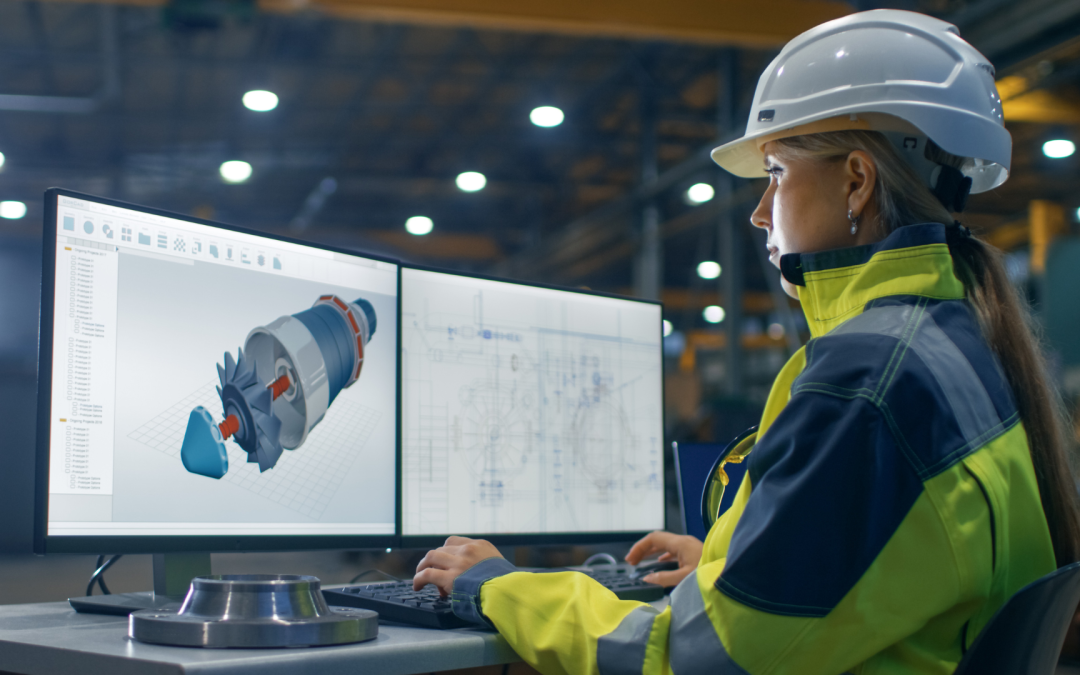
Studies across engineering and construction projects find that rework (often driven by design errors, miscommunication, and poor early validation) accounts for roughly 5–10% of total project costs, with some studies showing even higher impacts depending on industry and complexity.
Most companies searching for a 3D CAD consultant are not actually looking for drawings. They are looking for confidence, confidence that their product can be built, that tolerances will hold, and that design decisions made today will not create costly problems later in manufacturing or production.
At an early stage, basic CAD modeling may be enough. But as soon as real constraints enter the picture, materials, assemblies, suppliers, tooling, compliance, or scale, CAD becomes an engineering problem, not a drafting task. This is the point where choosing a professional CAD consultant matters.
The role shifts from simply creating geometry to applying engineering judgment, understanding manufacturability, and reducing technical and commercial risk.
A true CAD consultant does more than execute instructions. They validate inputs, challenge assumptions, and design with production realities in mind. For engineering-led companies, manufacturers, and product teams moving beyond concept-level work, the difference between “just CAD” and engineering-driven CAD consulting is often the difference between smooth execution and expensive rework.
What follows breaks down what separates true CAD consulting from basic modeling, when engineering-led CAD support becomes necessary, and how to judge whether you need execution help or an accountable engineering partner.
What a 3D CAD Consultant Actually Does
A 3D CAD consultant is responsible for far more than creating geometry that looks correct on a screen. In a professional context, CAD is a decision-making tool, one that directly influences cost, manufacturability, lead times, and downstream risk. This is where 3D CAD consulting diverges sharply from basic modeling work.
In practice, a professional 3D CAD consultant is routinely responsible for:
- Converting concepts, sketches, or legacy data into manufacturable 3D CAD models
- Applying engineering constraints related to materials, tolerances, and production processes
- Designing parts and assemblies to reduce rework, scrap, and late-stage design changes
- Anticipating manufacturing and assembly challenges before they become costly issues
- Supporting internal engineering, sourcing, and manufacturing teams with reliable, production-ready data
At the core of the role is the ability to translate incomplete or high-level requirements into production-ready CAD. Inputs are often fragmented, including early concepts, rough sketches, legacy files, supplier constraints, or evolving performance targets. A CAD consultant must interpret these inputs, resolve ambiguities, and convert them into structured models that can be confidently used by engineering, procurement, and manufacturing teams.
That translation process requires applying real engineering constraints. Materials are selected not only for function, but also for availability, cost, and manufacturability. Tolerances are defined with an understanding of how parts will actually be machined, molded, or assembled.
Design decisions account for stress, fit, wear, and serviceability, not just nominal dimensions. This is why CAD consultant services are often engaged alongside or in support of mechanical engineering teams, rather than as isolated drafting support.
Preventing Manufacturing Failures Through Engineering-Led CAD
An equally critical function of professional CAD consulting is failure prevention. Poorly considered CAD work often passes initial reviews, only to fail later during prototyping, tooling, or production. A CAD consultant designs with those later stages in mind, identifying issues early, such as unmachinable features, unrealistic tolerances, problematic assemblies, or material choices that create downstream bottlenecks.
Rather than operating in isolation, effective CAD consulting integrates directly into existing workflows. Consultants often act as an extension of internal teams, absorbing overflow work, accelerating timelines, or providing specialized expertise where internal resources are limited. The value is not speed alone, but accuracy, accountability, and reduced execution risk.
When CAD is treated as an engineering discipline rather than a drawing task, it becomes a stabilizing force in product development. That is the functional difference between basic modeling and professional CAD consulting, and the reason experienced teams engage a 3D CAD consultant when outcomes matter.
CAD Modeling vs. CAD Consulting
The difference between CAD modeling and CAD consulting is not academic. It directly affects cost, timelines, and production risk. Many teams assume these are interchangeable services until problems surface later in the process, when corrections are expensive and schedules are already under pressure.
A CAD modeler’s role is primarily execution. They take defined inputs and translate them into geometry. A professional CAD consultant, by contrast, is accountable for outcomes. They question assumptions, validate requirements, and optimize designs based on engineering and manufacturing realities. This distinction is central to why CAD consulting services are engaged in higher-stakes projects.
Key differences in responsibility and impact
| Aspect | CAD Modeling | CAD Consulting |
|---|---|---|
| Primary role | Executes provided instructions | Evaluates, validates, and optimizes requirements |
| Input quality | Assumes inputs are correct | Identifies gaps, risks, and inconsistencies |
| Engineering judgment | Minimal or none | Core responsibility |
| Manufacturability | Often considered late or not at all | Integrated from the start |
| Tolerances and materials | Applied as specified | Defined based on process and use case |
| Risk ownership | Limited to drawing accuracy | Shared responsibility for execution outcomes |
| Cost impact | Low upfront, high downstream risk | Higher upfront rigor, lower total cost |
| Typical use case | Concept visuals, basic drafting | Production, scaling, and risk-sensitive work |
The consequences of treating CAD as a drafting task rather than an engineering discipline are well known. Designs that appear correct in isolation often fail once exposed to real-world constraints. Common outcomes include parts that cannot be machined as designed, assemblies that require rework to fit, tooling changes after release, and compliance issues that surface too late to address efficiently.
These failures drive tangible costs. Manufacturing delays push back launch timelines. Rework and scrap inflate budgets. Engineering teams are forced into reactive problem-solving instead of controlled execution. In regulated or tolerance-sensitive environments, the risk extends beyond cost into liability and certification challenges.
A professional CAD consultant is engaged specifically to avoid these scenarios. By validating decisions early, aligning CAD with manufacturing processes, and designing with downstream execution in mind, CAD consulting shifts effort upstream where it is cheapest and most effective. The result is not simply better models, but fewer surprises and more predictable outcomes.
For organizations where CAD decisions carry real financial and operational consequences, the choice between modeling and consulting is not about preference. It is about responsibility, risk, and control over execution.
When You Need a Manufacturing-Focused CAD Consultant
A manufacturing CAD consultant becomes necessary when CAD decisions directly affect production cost, timelines, or risk. This typically occurs once a project moves beyond concept work and into execution, where errors are no longer theoretical and corrections are expensive.
Common scenarios where manufacturing-focused CAD consulting is required include:
- Transitioning from prototype to production
Designs that worked in early prototypes often fail at scale. A manufacturing CAD consultant adapts geometry, tolerances, and features for repeatable production. - Overloaded internal engineering teams
When internal teams lack capacity, outsourcing CAD support without manufacturing awareness introduces risk. Consulting fills the gap without lowering execution standards. - Designing for specific manufacturing processes
CAD for CNC mašinska obrada, injection molding, casting, or additive manufacturing must reflect process constraints from the start, not after release. - Regulated or tolerance-sensitive products
In medical, industrial, or precision-driven applications, CAD decisions affect compliance, fit, and performance. Manufacturing-focused consulting reduces late-stage failures.
In these situations, the role of a manufacturing CAD consultant is not to add drawings, but to control execution risk. By aligning CAD decisions with real production conditions, consulting ensures designs move forward with fewer delays, fewer revisions, and greater predictability.
Industries That Require Professional CAD Consulting
Professional CAD consulting is most critical in industries where precision, manufacturability, and execution risk directly affect cost, compliance, and time to market. In these environments, CAD is not a documentation step. It is a control point for engineering decisions with real operational consequences.
The industries below consistently require CAD consulting rather than basic modeling support because errors propagate quickly and become expensive to correct.
Where professional CAD consulting is essential
| Industrija | Why CAD Consulting Is Required | Primary Risk if CAD Is Treated as Modeling |
|---|---|---|
| Industrial manufacturing | Tight tolerances, complex assemblies, and production scalability | Rework, scrap, machining conflicts, assembly failures |
| Medical devices | Regulatory requirements, validation, and precision-critical components | Compliance delays, redesigns, certification risk |
| Mechanical products and assemblies | Interacting parts, load paths, and long-term reliability | Fit issues, premature wear, costly late-stage changes |
| Hardware startups scaling to production | Transition from prototype to volume manufacturing | Designs that cannot scale, tooling revisions, missed timelines |
In industrial manufacturing, CAD decisions must align with machining processes, tooling strategies, and assembly sequences. Professional CAD consulting ensures that models are not only dimensionally correct, but also realistic to produce at scale.
Medical device development introduces additional complexity. Here, CAD must support traceability, validation, and regulatory scrutiny. Small design oversights can trigger compliance issues that delay approvals and inflate development costs.
Mechanical products and assemblies demand careful attention to interfaces, tolerances, and load conditions. CAD consulting reduces risk by validating how components interact under real operating conditions, not just nominal geometry.
Hardware startups face a different challenge. Early designs often prioritize speed and proof of concept. As production volumes increase, those same designs must be reworked for manufacturability. Professional CAD consulting bridges this gap, adapting designs for repeatable production without derailing timelines.
Across all of these industries, the common factor is risk. When CAD decisions influence manufacturing feasibility, regulatory outcomes, or long-term reliability, professional CAD consulting becomes a requirement rather than an option.
What to Look for in a Professional CAD Consultant
Choosing between cad consultant services often comes down to responsibility. A professional CAD consultant is not defined by software proficiency alone, but by the ability to make and stand behind engineering decisions that affect production.
At a minimum, a qualified CAD consultant should demonstrate:
- Engineering literacy
The ability to understand functional requirements, tolerances, materials, and how design decisions affect performance and reliability. - Manufacturing knowledge
Practical familiarity with machining, molding, assembly, and production constraints, not just theoretical design rules. - Quality control discipline
Clear processes for model validation, revision control, and error prevention before designs reach manufacturing. - Integration with internal teams
The capacity to work within existing engineering, sourcing, and manufacturing workflows without creating friction or rework. - Accountability for outcomes
Ownership of execution quality, not just delivery of files or drawings.
The strongest cad consultant services operate as an extension of your engineering organization. They reduce risk, absorb responsibility, and allow internal teams to move faster with confidence, rather than transferring problems downstream.
How CAD Consulting Fits Into a Full Engineering Pipeline
CAD consulting delivers the most value when it is treated as part of a continuous engineering workflow rather than a standalone service. In a well-structured pipeline, CAD is the connective layer that links early requirements to validated engineering and, ultimately, to production.
In practice, CAD consulting fits into the engineering pipeline in three key ways:
- Acts as an entry point
CAD consulting often begins with concept development, legacy data cleanup, or design support. This creates early alignment on requirements, constraints, and feasibility before larger engineering decisions are locked in. - Integrates with mechanical engineering
As designs mature, CAD consulting supports and overlaps with mechanical engineering work. Geometry, tolerances, and materials are refined alongside analysis, validation, and design optimization. - Connects directly to prototyping and manufacturing
Production-ready CAD enables efficient prototyping, tooling, and manufacturing execution. Decisions made upstream reduce rework, shorten lead times, and improve predictability downstream.
This pipeline approach is central to how X-PRO CAD operates. CAD consulting is not positioned as a one-off deliverable, but as the starting point of an ongoing engineering relationship.
By aligning CAD, engineering, and manufacturing under a single execution framework, X-PRO CAD functions as a long-term engineering partner, supporting clients from early design through production rather than handing off responsibility at each stage.
Final Thoughts: Turning An Idea Into A Real Product
Turning an idea into a real product does not happen all at once. It is a structured process that moves from early concept and design into prototyping, manufacturing planning, and production. When each step is approached deliberately, complexity is reduced and costly mistakes are avoided.
At X-PRO CAD, we support that process end to end. Our work spans 3D CAD, mechanical engineering, prototyping, and manufacturing support, helping teams move from concept to execution with clarity and control. Whether you are refining a design, preparing for production, or evaluating next steps, our role is to reduce risk and keep progress moving forward.
If you would like to discuss a project or ask questions, contact us at project.inquiries@x-professionals.com or call (571) 583-3710. We are available to help evaluate your idea and determine the most practical path to execution.
Najčešća pitanja
Is a 3D CAD consultant different from a CAD designer?
Yes. A CAD consultant applies engineering judgment and manufacturing awareness, while a CAD designer typically executes predefined instructions.
When should I use CAD consulting services instead of CAD modeling?
When CAD decisions affect manufacturability, tolerances, cost, or production risk rather than just visuals or documentation.
Do CAD consulting services include manufacturing considerations?
Yes. Professional CAD consulting accounts for machining, assembly, materials, and production constraints from the start.
Can a CAD consultant support internal engineering teams?
Yes. CAD consultants often integrate directly with internal teams to extend capacity and maintain execution quality.
Is CAD consulting suitable for production-scale projects?
Yes. CAD consulting is most valuable when designs are moving toward production and errors carry financial or operational risk.


 SR
SR  EN
EN
Скорашњи коментари