
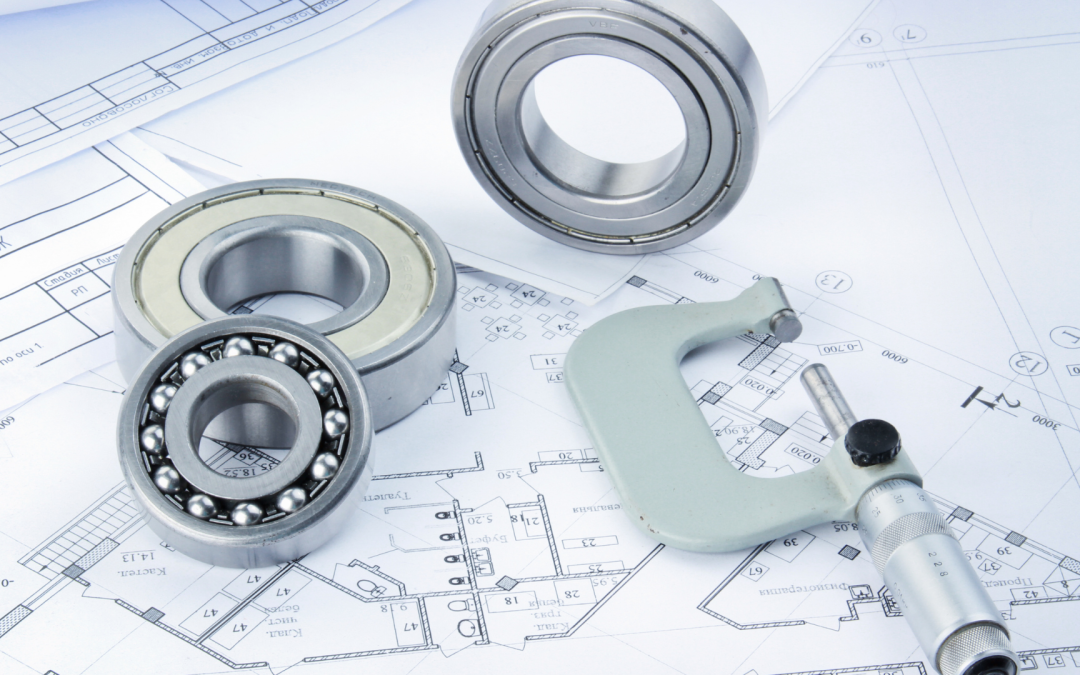
Studies show that fixing mistakes and rework typically consumes 5–10% of total project costs, driven largely by errors in design and data that could be caught earlier with precision-led engineering practices.
Choosing between CAD engineering companies is not a branding decision. It is an execution decision that directly impacts manufacturability, cost control, timelines, and downstream risk.
Many providers claim CAD expertise. Far fewer function as true engineering partners capable of delivering production-ready, manufacturing-aware outcomes through professional CAD engineering services. The difference is not software proficiency; it is how precision, accountability, and manufacturing constraints are built into the engineering process.
This guide explains how to evaluate CAD engineering companies based on execution capability rather than marketing claims, and how to select a partner that can reliably support real-world manufacturing requirements.
What CAD Engineering Companies Actually Do (Beyond “CAD Services”)
At a functional level, CAD engineering companies translate requirements into structured, editable engineering data. That data is not an end deliverable, it is the foundation for downstream activities such as analysis, prototyping, tooling, and production.
The critical distinction is not whether a provider can create CAD models, but how much engineering responsibility they assume for those models.
Many lower-tier CAD engineering services focus primarily on geometry creation. Their role ends once a shape exists on screen. Precision-driven CAD engineering companies operate at a higher level by integrating:
- Engineering intent, not just nominal geometry
- Manufacturing constraints based on real production methods
- Tolerance strategy aligned with function and assembly
- Revision control managed as a formal engineering process
- Downstream usability across machining, inspection, and production workflows
This difference determines whether CAD files function as reliable production assets or introduce ambiguity that leads to interpretation, rework, and downstream risk.
The Hidden Risk in Generic CAD Engineering Services
Many CAD engineering services market themselves as flexible, fast, and affordable. In practice, this positioning often reflects a lack of engineering accountability rather than efficiency.
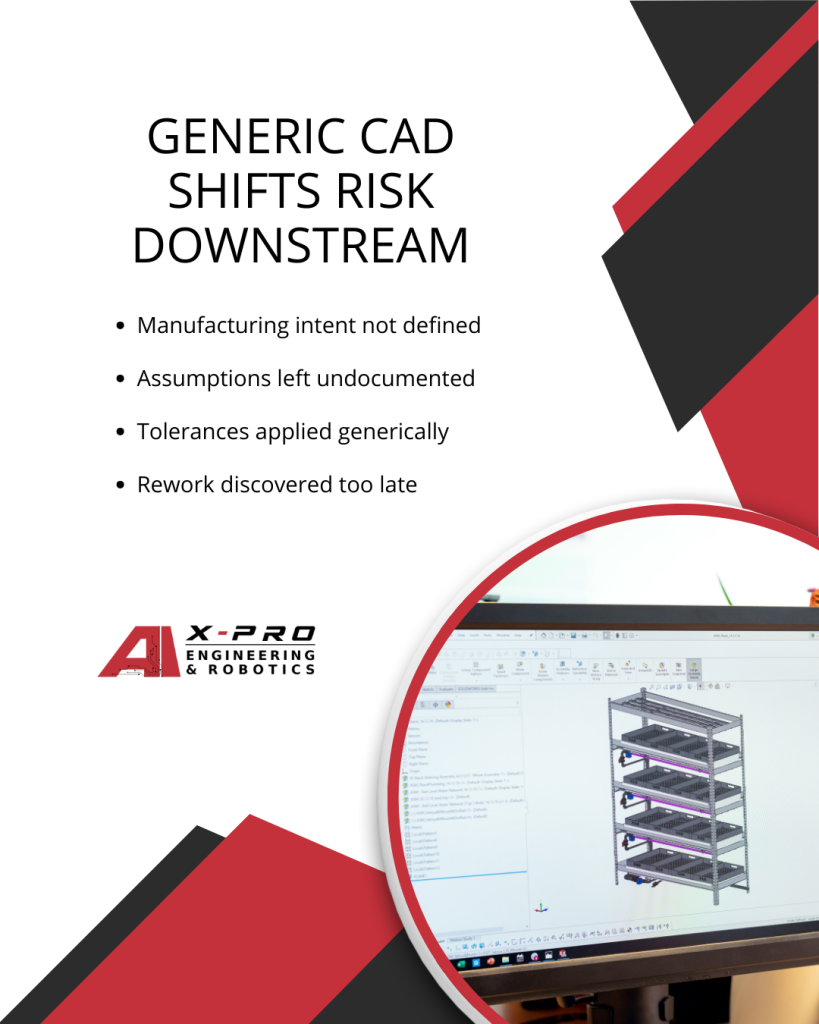
Common characteristics of generic CAD engineering services include:
- Models created without manufacturing or assembly context
- Critical assumptions left undocumented or implicit
- Tolerances applied inconsistently or generically
- Design intent implied rather than explicitly defined
These gaps do not disappear downstream. They transfer risk directly to manufacturing and assembly teams, where ambiguity becomes rework, delays, and cost overruns.
This failure pattern is examined in detail in our article on why products fail when CAD work is treated as a commodity rather than an engineering responsibility.
CAD itself is not the problem. The issue arises when CAD is treated as a visual output instead of an execution-driven engineering asset.
Precision-driven CAD engineering companies eliminate this ambiguity by applying engineering discipline, manufacturing awareness, and structured control throughout the modeling process.
Generic CAD Services vs. Precision-Driven CAD Engineering
This comparison highlights the practical differences between CAD services that focus on file delivery and CAD engineering approaches built around execution, accountability, and manufacturing readiness.
| Area of Responsibility | Generic CAD Engineering Services | Precision-Driven CAD Engineering Companies |
|---|---|---|
| Primary Focus | Geometry creation | Engineering execution |
| Manufacturing Context | Often excluded | Integrated from the start |
| Design Intent | Implied or assumed | Explicitly defined and documented |
| Tolerance Strategy | Generic or inconsistent | Function- and assembly-driven |
| Revision Handling | Informal file updates | Structured change control |
| Downstream Usability | Requires interpretation | Production-ready and reliable |
| Risk Ownership | Shifted to manufacturing | Managed at the engineering level |
CAD Engineering Outsourcing: When It Works and When It Fails
CAD engineering outsourcing can be highly effective when it is structured around execution rather than cost alone. When done correctly, it allows companies to scale engineering capacity, reduce internal workload, and maintain control over quality and timelines.
Outsourcing works when CAD teams are integrated into existing engineering workflows and held to the same standards as in-house resources.
Outsourcing fails when those conditions are not met.
Common failure points include:
- Loosely defined scope, leading to assumptions and inconsistent deliverables
- Implicit quality standards that are never formally enforced
- Fragmented engineering accountability, where no one owns accuracy end-to-end
- Detached CAD vendors operating without manufacturing or product context
In these scenarios, outsourcing may reduce short-term cost, but it increases downstream risk. Internal teams spend more time reviewing, correcting, and clarifying outsourced work, eliminating the intended efficiency gains.
Successful CAD engineering outsourcing requires a partner that operates as an extension of your engineering function. That partner must take clear ownership over accuracy, revision control, and deliverable quality, not just task completion.
When accountability, standards, and manufacturing context are embedded into the outsourcing model, CAD engineering outsourcing becomes a force multiplier rather than a liability.
What Defines a True CAD Engineering Partner
A CAD engineering partner does more than execute individual tasks. They assume responsibility for engineering outcomes across the lifecycle of a project.
The defining difference between a vendor and a partner is not speed or software proficiency, it is ownership.
A true CAD engineering partner demonstrates that ownership through the following characteristics.
1. Manufacturing-Aware Engineering
A credible partner designs with machining, tooling, assembly, inspection, and material behavior in mind from the start. Geometry is developed in direct alignment with how parts will actually be produced and assembled.
Manufacturing CAD engineering is not treated as a downstream handoff or a corrective step. It is embedded into every modeling decision to reduce ambiguity, prevent rework, and support predictable execution.
2. Precision as a Process, Not a Claim
Precision-driven CAD engineering companies do not rely on marketing language to signal accuracy. They define how precision is achieved, verified, and maintained throughout the project.
This includes:
- Intentional tolerance strategy
- Consistent use of reference geometry
- Verification and validation workflows
Precision becomes measurable and repeatable, rather than assumed.
3. Structured Communication and Documentation
Engineering decisions carry consequences. A true CAD engineering partner documents design intent, assumptions, constraints, and changes in a structured and traceable way.
This documentation prevents interpretation errors, reduces dependency on tribal knowledge, and protects downstream manufacturing and assembly teams from ambiguity.
4. Controlled Revision Management
Revisions are treated as formal engineering events, not informal file updates. Professional CAD engineering companies manage changes through defined processes that preserve version integrity and maintain alignment across teams.
Controlled revision management reduces confusion, prevents outdated data from entering production, and ensures accountability at every stage.
5. Accountability Across the Lifecycle
A real CAD engineering partner remains engaged beyond initial file delivery. They stay aligned through prototyping, validation, and manufacturing handoff to ensure engineering intent is preserved in execution.
This lifecycle accountability is what transforms CAD from a deliverable into a reliable production asset.
Manufacturing CAD Engineering vs. Design-Only CAD
Manufacturing CAD engineering focuses on how a part will actually be produced, assembled, inspected, and sustained in real-world manufacturing conditions. The goal is not to create idealized geometry, but to deliver CAD data that performs reliably throughout the production lifecycle.
This approach accounts for factors that directly influence cost, lead time, and quality, including:
- Tool access and machining strategy, ensuring features can be produced efficiently and repeatedly
- Feature stack-up and tolerance accumulation, preventing fit and function issues at assembly
- Material behavior under load and heat, accounting for deformation, wear, and thermal effects
- Assembly sequence considerations, reducing complexity and minimizing downstream handling errors
Design-only CAD, by contrast, often prioritizes visual correctness or nominal geometry, a distinction explored further in engineering vs. design and why both are essential for successful products. While models may appear complete, they frequently omit the constraints and decisions required for manufacturability.
Manufacturing CAD engineering optimizes outcomes. Design-only CAD optimizes appearance.
If a CAD provider cannot speak fluently about production methods, tolerancing strategy, or assembly constraints, they are not operating at an engineering-partner level. They are producing models, not engineering solutions.
Mechanical CAD Engineering Services: Where Precision Matters Most
Mechanical CAD engineering services operate at a higher level of responsibility than basic modeling. Decisions made at this stage directly affect tooling accuracy, regulatory compliance, durability, and real-world performance.
Errors introduced here do not remain isolated. They propagate into manufacturing, testing, and field use, where correction becomes expensive, time-consuming, or impossible.
Precision-driven mechanical CAD engineering services focus on engineering execution rather than file creation. This includes:
- Functional requirement translation, ensuring geometry supports real operating conditions
- Interface definition between components, preventing fit, alignment, and assembly issues
- Structural and thermal considerations, accounting for load, vibration, and heat
- Regulatory and industry standards, where compliance and documentation are mandatory
This level of work requires experienced engineers who understand both design intent and production realities—not CAD operators executing instructions in isolation.
Mechanical CAD Engineering vs. Basic CAD Modeling
This comparison outlines the difference between basic CAD modeling focused on geometry creation and mechanical CAD engineering services that assume responsibility for functional performance and manufacturing outcomes.
| Area of Responsibility | Basic CAD Modeling | Mechanical CAD Engineering Services |
|---|---|---|
| Primary Objective | Create geometry | Engineer functional systems |
| Risk Level | Low to moderate | High and outcome-critical |
| Functional Requirements | Often implied | Explicitly translated into design |
| Component Interfaces | Visual alignment | Engineered fit and interaction |
| Structural / Thermal Analysis | Typically excluded | Considered during design |
| Regulatory Awareness | Minimal or none | Integrated where applicable |
| Manufacturing Impact | Discovered later | Addressed during engineering |
| Required Expertise | CAD operators | Experienced mechanical engineers |
Why This Distinction Matters
Mechanical CAD engineering is where products succeed or fail in production and use. Treating this work as simple CAD output introduces risk that cannot be corrected downstream.
Companies that rely on precision-driven mechanical CAD engineering services reduce uncertainty, protect manufacturing investment, and deliver products that perform as intended in the real world.
How to Evaluate CAD Engineering Companies (Practical Criteria)
When comparing CAD engineering companies, the most important factor is not software capability or turnaround speed. It is how much execution responsibility the provider is willing—and able—to assume.
Effective evaluation requires asking questions that reveal how CAD work will perform in manufacturing, not just how it looks on screen.
Key criteria to assess include:
- Manufacturing alignment
Can the provider clearly explain how their CAD supports machining, assembly, inspection, and production workflows—not just design intent? - Defined quality standards
Do they establish explicit accuracy, tolerancing, and documentation standards upfront, or are quality expectations left implicit? - Revision and change control
How are revisions handled? Are changes tracked, documented, and approved through a controlled process, or managed informally through file updates? - Ownership of engineering outcomes
What responsibility does the company assume when errors, ambiguities, or downstream issues arise? Is accountability clearly defined? - Lifecycle support capability
Can the provider support work beyond CAD delivery, such as prototyping, validation, or manufacturing handoff, if required?
These questions expose how a CAD engineering company actually operates. Vendors focus on task completion. Engineering partners focus on outcomes.
Evaluating CAD engineering companies through this lens allows decision-makers to reduce risk, improve predictability, and select partners capable of supporting real-world execution.
Why Precision-Driven CAD Engineering Reduces Total Cost
Precision-driven CAD engineering services are often perceived as more expensive at the outset. In reality, they consistently reduce total project cost by controlling risk at the point where it is cheapest to manage, during engineering.
Cost overruns rarely originate in manufacturing. They originate in ambiguous or incomplete engineering data that forces interpretation downstream.
Precision-focused CAD engineering reduces total cost by:
- Eliminating rework through clear design intent, defined tolerances, and manufacturing-aware geometry
- Shortening production timelines by minimizing clarification cycles, late-stage corrections, and redesign
- Preventing tooling and assembly errors that arise from incomplete or inconsistent CAD data
- Reducing internal coordination overhead by delivering production-ready files that require less internal review and intervention
These savings compound across the project lifecycle. Fewer iterations, fewer interruptions, and fewer surprises translate directly into lower cost and faster delivery.
Cost efficiency in CAD engineering is not achieved by cutting scope or reducing effort. It is achieved through control, discipline, and accountability at the engineering level.
Organizations that invest in precision-driven CAD engineering shift cost forward, where it is predictable and manageable, rather than absorbing it later in manufacturing, tooling, and rework.
Final Thoughts: Choosing CAD Engineering Companies That Execute
The most reliable CAD engineering companies are not the loudest or the most creative. They are the most disciplined.
A precision-driven CAD engineering partner reduces uncertainty by aligning design intent with manufacturing reality and maintaining accountability throughout the engineering lifecycle. As products become more complex and production timelines continue to tighten, that discipline becomes a requirement rather than a differentiator.
When evaluating CAD engineering services, prioritize execution, accountability, and manufacturing readiness. Those factors, not software proficiency or speed alone, determine whether CAD accelerates your business or introduces downstream risk.
At X-PRO CAD, we operate as an execution-focused engineering partner. Our work spans CAD engineering, mechanical engineering, prototyping, and product development, enabling teams to move from concept to production with fewer handoffs, fewer errors, and greater control. The objective is not just to deliver CAD files, but to ensure those files perform reliably in real-world manufacturing environments.
If you would like to discuss a project or evaluate whether your current CAD approach supports production-ready execution, contact us at project.inquiries@x-professionals.com or call (571) 583-3710. We are available to review your requirements and help determine the most practical path forward.
Najčešća pitanja
What is the difference between CAD engineering companies and basic CAD service providers?
CAD engineering companies operate with engineering accountability. They focus on manufacturing readiness, tolerances, documentation, and downstream usability. Basic CAD service providers typically focus on geometry creation without assuming responsibility for production outcomes.
Are CAD engineering services intended for manufacturing or only for design support?
Professional CAD engineering services support both design and manufacturing. When CAD is developed with manufacturing constraints, tolerance strategy, and assembly considerations in mind, it can be used directly for tooling, production planning, and inspection.
When does CAD engineering outsourcing make sense for a company?
CAD engineering outsourcing is most effective when internal teams need additional capacity, specialized expertise, or scalable support, but still require strict quality control and engineering accountability. It works best when the outsourced team functions as an extension of the internal engineering group.
How do CAD engineering companies manage revisions and design changes?
Precision-driven CAD engineering companies treat revisions as formal engineering events. Changes are documented, controlled, and tracked to maintain version integrity and prevent outdated or incorrect data from entering manufacturing.
What should I look for when choosing a CAD engineering partner?
Look for a partner that can explain how their CAD supports manufacturing, defines quality standards upfront, manages revisions systematically, and remains accountable through manufacturing handoff. These factors indicate whether a provider operates as a vendor or as a true engineering partner.


 SR
SR  EN
EN
Скорашњи коментари