

In engineering and construction projects, rework, often caused by design errors, can represent 5 to 20 percent of total project costs, creating major cost and schedule liabilities for teams without strong drafting controls.
Freelance CAD drafting services remain a popular option for engineering and product teams that need reliable drafting support without expanding internal headcount.
When workloads increase unexpectedly, timelines compress, or short-term projects require additional hands, turning to freelance CAD drafters is often the most practical and immediate solution. For many organizations, this approach provides a way to maintain momentum without committing to long-term staffing changes.
The appeal is straightforward. Freelance CAD drafting offers flexibility, fast onboarding, and access to remote CAD drafting services that can be engaged on demand. Teams can scale drafting capacity up or down as needed, bring in CAD drafting freelancers with specific software or industry experience, and address defined tasks efficiently.
In situations where scope is clear and requirements are well documented, freelance support can integrate smoothly into existing workflows.
At the same time, freelance CAD drafting services are most effective when used intentionally. They are well suited to certain types of work and project conditions, but they are not a universal solution for every engineering challenge. Understanding where freelance CAD drafters deliver the most value and where additional structure may be required allows teams to use this model effectively while avoiding unnecessary friction.
What Freelance CAD Drafting Services Typically Provide
Freelance CAD drafting services are most effective when expectations are clearly defined from the outset. While individual capabilities vary, most freelance CAD drafters focus on execution-oriented drafting tasks that support internal engineering teams rather than replacing them. Understanding what is typically included helps teams scope work correctly and avoid misalignment later in the project.
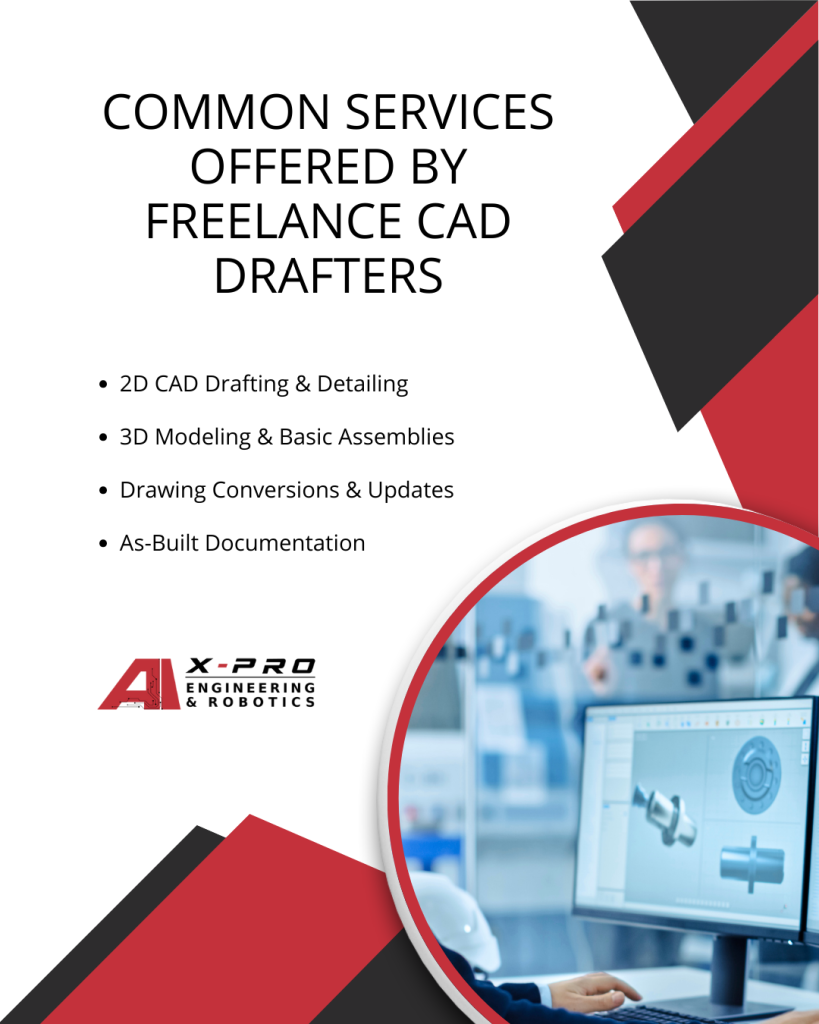
Common services offered by freelance CAD drafters
In practice, CAD drafting freelancers are commonly engaged for:
- 2D CAD drafting and detailing
Creation and revision of technical drawings, layouts, and production-ready details based on existing designs or specifications. - 3D modeling and basic assemblies
Development of part models and simple assemblies used for visualization, fit checks, or downstream documentation. - Drawing conversions and updates
Converting legacy files between CAD platforms, updating outdated drawings, or aligning documentation with current revisions. - As-built documentation
Producing accurate as-built drawings that reflect changes made during fabrication, installation, or prototyping.
These services are often delivered remotely, making remote CAD drafting services especially attractive for teams working across locations or time zones.
Typical engagement structure
Most freelance CAD drafting engagements follow a straightforward working model:
- Hourly or project-based pricing, depending on task clarity and duration
- Direct communication with the drafter, usually without intermediary project management
- Tooling and file ownership considerations, including:
- Which CAD software is used
- How files are transferred and versioned
- Who retains ownership of final deliverables
Because freelance CAD drafters operate as independent contributors, variability is a defining characteristic of this model. Differences in drafting standards, availability, and working methods are normal and should be expected. When acknowledged upfront and managed appropriately, this variability does not diminish the value of freelance CAD drafting services, it simply reinforces the importance of clear scope, documentation, and oversight.
Key Advantages of Using Freelance CAD Drafting Services
When used in the right context, freelance CAD drafting services provide clear, measurable advantages for engineering teams. Their value lies less in replacing internal expertise and more in adding targeted capacity, efficiency, and flexibility where it is needed most. Below are the primary reasons teams continue to rely on freelance CAD drafters as part of their resourcing strategy.
Flexibility and On-Demand Capacity
One of the strongest advantages of working with freelance CAD drafters is the ability to scale drafting support quickly.
Engineering workloads are rarely static. Project timelines compress, drawing volume spikes, or internal teams become temporarily constrained. In these situations, on-demand CAD drafting support allows teams to respond immediately without restructuring their organization.
Key benefits include:
- Rapid onboarding compared to hiring full-time staff
- Ability to scale drafting capacity up or down as workload changes
- No long-term employment commitments for short-duration needs
This flexibility makes remote CAD drafting services especially effective for temporary demand, overflow work, or project-based requirements where speed matters more than permanence.
Cost Efficiency for Defined, Well-Scoped Work
For clearly defined tasks, CAD drafting freelancers can be a cost-efficient option.
Freelance CAD drafting services are particularly well suited for work that is:
- Clearly scoped
- Repetitive or standardized
- Limited in duration or volume
Because freelancers operate without the overhead associated with full-time employees, such as benefits, idle time, or internal training, teams often achieve lower effective costs for specific drafting needs. This model works best when inputs, outputs, and expectations are well documented and agreed upon in advance.
Access to Specialized Experience
Another key advantage of freelance CAD drafting services is access to specialized skills without long-term investment.
Teams can source freelance CAD drafters with experience in:
- Specific CAD platforms and file formats
- Particular industries or product types
- Niche drafting requirements or legacy systems
This allows organizations to match the right expertise to the task at hand, rather than forcing internal teams to stretch beyond their primary focus. For short-term or highly specific needs, this targeted access can be more efficient than developing in-house capability.
| Advantage | Why It Matters | Best Use Case |
|---|---|---|
| Flexibility & On-Demand Capacity | Quickly scale drafting support without long-term commitments | Workload spikes, short-term projects |
| Cost Efficiency for Scoped Work | Lower overhead for clearly defined drafting tasks | Repetitive or standardized drawings |
| Access to Specialized Experience | Engage CAD drafting freelancers with niche skills or platform expertise | Platform-specific or industry-specific work |
When aligned with clear scope and internal oversight, freelance CAD drafting services remain a practical and valuable tool for engineering teams seeking speed, efficiency, and targeted support.
When Freelance CAD Drafting Services Work Best
Freelance CAD drafting services deliver the strongest results when the type of work and project conditions align with how freelance CAD drafters typically operate.
Rather than being a universal solution, this model is best applied to well-defined scenarios where flexibility and execution speed are the primary requirements.
Best-fit scenarios for freelance CAD drafting
Engineering teams most often rely on freelance CAD drafting services in the following situations:
- Overflow drafting during peak periods
When internal teams are temporarily overloaded, freelance CAD drafters can provide short-term capacity to keep projects moving without disrupting long-term staffing plans. - Legacy drawing updates
Updating older drawings, converting files, or bringing documentation up to current standards is well suited to CAD drafting freelancers, particularly when design intent is already established. - One-off projects with clear requirements
For isolated tasks with defined inputs and outputs, on-demand CAD drafting support allows teams to execute efficiently without unnecessary coordination overhead. - Early-stage concepts not yet tied to manufacturing
At early concept or pre-production stages, remote CAD drafting services can support visualization, layout development, and basic assemblies before manufacturing constraints are fully defined.
In these contexts, freelance CAD drafting services provide speed, adaptability, and focused execution without introducing unnecessary complexity.
Conditions that enable success
Across all successful engagements, three factors consistently determine outcomes:
- Clear scope
Tasks, assumptions, and constraints must be explicitly documented before work begins. Ambiguity is the primary source of friction in freelance CAD drafting. - Defined deliverables
File formats, drawing standards, revision expectations, and acceptance criteria should be agreed upon in advance to avoid rework. - Internal technical oversight
While CAD drafting freelancers execute the work, internal teams retain responsibility for technical decisions, reviews, and final approval.
When these conditions are met, freelance CAD drafting services function as a reliable extension of internal teams. Used intentionally and within the right boundaries, they offer a practical way to maintain momentum without compromising control or clarity.
How Engineering Teams Successfully Work With Freelance CAD Drafters
Successful use of freelance CAD drafting services is rarely accidental. Outcomes depend far more on how the work is structured and managed than on the individual freelancer alone. Engineering teams that treat freelance CAD drafters as an extension of their workflow, rather than an ad hoc solution, consistently see better results.
Clear Documentation and Inputs
The foundation of effective collaboration with CAD drafting freelancers is clear, complete input information.
Before work begins, engineering teams should provide:
- Detailed written briefs outlining scope, assumptions, and constraints
- Reference models, sketches, or existing drawings
- Applicable drafting standards and naming conventions
Just as important, explicit tolerance and formatting requirements should be defined upfront. Freelance CAD drafters cannot infer design intent or manufacturing priorities without clear guidance. The more precise the inputs, the less rework is required downstream.
Defined Review and Approval Process
Engineering teams that succeed with remote CAD drafting services establish a structured review process from the start.
Best practices include:
- Regular checkpoints to review progress and catch issues early
- Version control discipline to prevent file conflicts or outdated revisions
- Clear responsibility for final sign-off, typically retained by the internal engineering lead
This approach ensures that on-demand CAD drafting support integrates cleanly into existing workflows rather than operating in isolation.
Realistic Expectations Around Accountability
A critical factor in successful freelance engagements is aligning expectations around responsibility.
In most cases:
- Freelance CAD drafters execute defined tasks based on provided inputs
- Internal engineering teams retain technical ownership, decision-making authority, and risk responsibility
Freelance CAD drafting services perform best when internal coordination is strong and roles are clearly defined. When accountability is understood and managed intentionally, collaboration becomes predictable and efficient.
| Management Area | What Teams Should Do | Why It Matters |
|---|---|---|
| Documentation & Inputs | Provide detailed briefs, references, and standards | Reduces ambiguity and rework |
| Review & Approval | Establish checkpoints and version control | Maintains quality and alignment |
| Accountability | Retain internal ownership of technical decisions | Prevents gaps in responsibility |
Limitations to Be Aware of When Using Freelance CAD Drafting Services
Freelance CAD drafting services offer clear advantages, but like any resourcing model, they come with structural limitations that engineering teams should account for upfront. Acknowledging these realities is not a criticism of freelance CAD drafters. It is a practical step toward using this model effectively and avoiding misaligned expectations.
Variability as a structural reality
Because freelance CAD drafting services rely on individual contributors, a certain level of variability is inherent. This can include differences in:
- Drafting standards and documentation conventions
- Availability from one project to the next
- Long-term continuity across extended programs or product lifecycles
This variability is normal within remote CAD drafting services and reflects the independent nature of freelance work rather than a lack of capability.
Scope of responsibility
In most engagements, CAD drafting freelancers are responsible for executing clearly defined tasks based on provided inputs. Their responsibility typically does not extend beyond the assigned scope. As a result:
- Technical ownership remains with the internal engineering team
- Cross-functional coordination is handled internally
- Final accountability does not shift with task execution
This division of responsibility works well for well-scoped drafting work, but it requires intentional management.
Situations that introduce additional complexity
Some project conditions can be more challenging for freelance CAD drafting services, including:
- Projects that span multiple disciplines or engineering functions
- Work that is tightly coupled to complex manufacturing requirements
- Situations where accountability must extend beyond drawings and into downstream outcomes
In these cases, on-demand CAD drafting support may still play a role, but additional structure, coordination, or oversight is often required.
Understanding these limitations allows engineering teams to position freelance CAD drafting services appropriately. When viewed as structural characteristics rather than personal shortcomings, they become factors to plan around rather than obstacles to avoid.
Freelancers vs. Structured CAD Partners: Understanding the Difference
Engineering teams often evaluate freelance CAD drafting services alongside more structured CAD partners when planning how to resource drafting and engineering work. The difference between these two models is not about quality or capability. It is about structure, responsibility, and how work is coordinated.
Freelance CAD drafting services
Freelance CAD drafting services are typically centered around individual contributors who focus on executing defined tasks. Common characteristics include:
- Individual freelance CAD drafters working independently
- Task-focused execution based on provided inputs
- Client-managed coordination, reviews, and approvals
- Direct communication with the CAD drafting freelancer
- Flexible engagement through on-demand CAD drafting support
This model works well when scope is clear, technical ownership remains internal, and coordination requirements are limited.
Structured CAD providers
Structured CAD providers operate with a different delivery model that is designed to support broader or more complex requirements. These typically include:
- Team-based delivery rather than single contributors
- Internal quality assurance processes and standardized workflows
- Consistent drafting standards across projects
- Broader alignment with engineering and manufacturing requirements
- Greater continuity for long-term or multi-phase work
Remote CAD drafting services delivered through structured providers often reduce coordination overhead by absorbing responsibility for standards, consistency, and internal review.
Using both models effectively
In practice, many engineering teams use both approaches at different stages of a project:
- Freelance CAD drafting services for overflow work, short-term needs, or isolated tasks
- Structured CAD providers for larger programs, complex assemblies, or manufacturing-aligned deliverables
Understanding the distinction allows teams to select the right model for each phase of work, rather than forcing one approach to fit every scenario.
Final Thoughts: Using Freelance CAD Drafting Services Intentionally
Freelance CAD drafting services continue to play an important role in how engineering teams manage workload, cost, and flexibility. When applied in the right situations, freelance CAD drafters provide fast, practical support that helps teams maintain momentum without expanding internal headcount. For overflow drafting, legacy updates, and well-scoped tasks, this model remains both effective and efficient.
At the same time, results depend on how freelance CAD drafting services are used. Clear scope, defined deliverables, and strong internal technical oversight are what turn flexibility into reliable output. When expectations are aligned and coordination is intentional, remote CAD drafting services integrate smoothly into engineering workflows and support real progress rather than creating downstream friction.
As projects grow in complexity, span multiple disciplines, or move closer to manufacturing, many teams supplement freelance CAD drafting with more structured support. The goal is not to replace freelancers, but to ensure that the delivery model matches the level of responsibility, coordination, and risk involved at each stage.
At X-PRO CAD, we work with engineering teams that use freelance CAD drafting services as part of a broader execution strategy. Our role is to provide structured, production-aware CAD and engineering support when accountability, consistency, and manufacturing alignment become critical.
If you are evaluating how to balance freelance CAD drafting services with more structured engineering support, or want to ensure your CAD workflows remain reliable as project demands increase, contact X-PRO CAD at project.inquiries@x-professionals.com or call (571) 583-3710 to discuss your requirements.
Najčešća pitanja
What types of projects are best suited for freelance CAD drafting services?
Freelance CAD drafting services are best suited for clearly defined, execution-focused tasks. Common examples include overflow drafting during peak periods, legacy drawing updates, file conversions, and one-off projects with well-documented requirements. When scope, deliverables, and review expectations are clear, freelance CAD drafters can integrate efficiently into existing workflows.
How do freelance CAD drafters differ from in-house CAD staff?
Freelance CAD drafters typically operate as independent contributors engaged on a short-term or project basis. Unlike in-house staff, they do not provide long-term continuity or internal coordination by default. Engineering teams retain responsibility for technical decisions, standards, and approvals when working with CAD drafting freelancers.
Are remote CAD drafting services reliable for professional engineering work?
Remote CAD drafting services can be reliable when properly managed. Success depends on clear documentation, defined review processes, and internal technical oversight. Location is less important than communication quality, version control, and alignment on drafting standards.
When should a team consider moving beyond freelance CAD drafting services?
Teams often move beyond freelance CAD drafting services when projects become more complex, involve multiple disciplines, or require closer alignment with manufacturing. In these situations, the need for standardized processes, internal quality control, and extended accountability increases.
Can freelance CAD drafting services and structured CAD providers be used together?
Yes. Many engineering teams use freelance CAD drafting services for short-term or well-scoped tasks while relying on structured CAD providers for larger programs or manufacturing-aligned work. Using both models strategically allows teams to balance flexibility, cost control, and execution reliability.


 SR
SR  EN
EN
Скорашњи коментари