
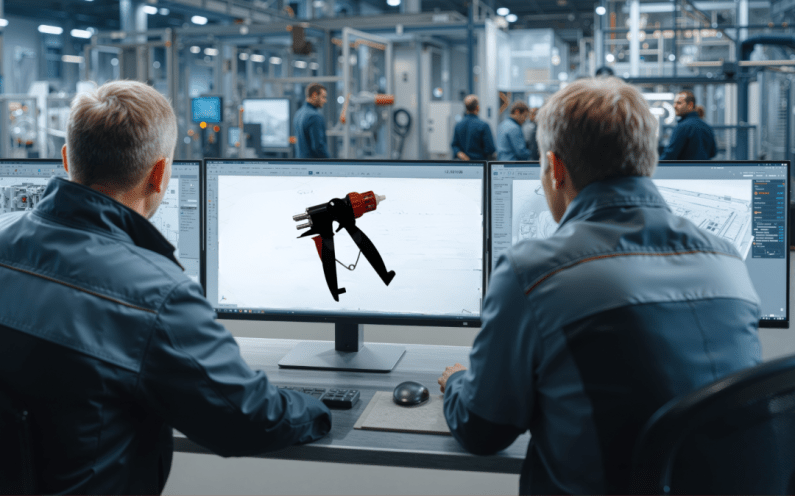
When a client from New Orleans reached out with a challenge, we were more than excited to take it on. They were using a premium spray-foam insulation gun—well-known in the industry, but also very expensive. Their goal? Build their own improved, cost-effective version that retained the best features of the original while eliminating its weaknesses.
This project became the foundation of a much larger system we’re developing for them, and today we’re sharing an inside look at how we completely reverse-engineered and redesigned a complex spray gun, taking it all the way to a fully functional prototype.
Understanding the Goal
The client brought us a competitor’s sprayer and explained exactly what they liked—and what they didn’t. They wanted a custom-built tool that would:
- Perform as well or better than the competitor
- Reduce manufacturing cost
- Improve usability
- Be optimized for mass production
Our team got to work immediately, moving from concept to engineering, and then into detailed CAD development.
Breaking Down the Engineering
The final design consists of seven main components, primarily made from high-grade plastic combined with stainless steel elements where strength and durability are critical.
Key Components:
- Ergonomic handle
- Top housing
- Connector piece linking the main body to the nozzle
- Mixing chamber
- Reinforced metal barrel
- Hose connectors
- Safety trigger mechanism
With the design at about 95% completion at the time of review, the only items missing in the initial model were the hose assembly and spring—added later in the physical prototype.
To ensure clarity and precision, we created multiple section views of the assembly, giving both our engineering team and the client a complete picture of airflow, mixing behavior, and mechanical interaction inside the unit.
Comparing to the Competitor
The competitor product served as our benchmark. While it offered strong performance, it lacked certain ergonomic and functional enhancements our client wanted. After analyzing it in detail, we began reshaping the design—for improved usability, visual appeal, and manufacturability.
The result? A sleek, modern, and more efficient spray gun design that both looks and feels like a next-level upgrade.
Moving Into Prototyping
Once the CAD model was approved, we built a 3D-printed prototype, painted and assembled for real-world testing.
Despite being made from 3D-printed components—which can be fragile—the prototype is structurally reinforced with an internal metal barrel. This ensures that the high PSI stresses stay contained within the hoses and metal elements, not the printed shell.
During testing, the prototype allowed us to:
- Validate ergonomics
- Check fit and alignment of components
- Test trigger and safety functions
- Understand assembly workflow
- Examine pressure behavior leading up to the nozzle
Side-by-side with the competitor’s unit, our prototype holds its own—and in many ways looks even better.
Prepared for Mass Manufacturing
The design is now fully optimized for injection molding, meaning every part has been prepared for:
- Draft angles
- Mold separation
- Material flow
- Structural reinforcement
- Tolerances and precision fits
This ensures a smooth transition into high-volume production once the client completes field testing and signs off on final adjustments.
Complete Documentation Included
As with all projects, we delivered full engineering documentation, including:
- Detailed CAD files
- Exploded views
- Bill of materials
- Assembly instructions
- Tolerance and material specs
This documentation guarantees seamless manufacturing and reduces potential errors in large-scale production.
Final Thoughts
This project is a powerful example of how reverse engineering can lead to something better—more efficient, more affordable, and more tailored to real user needs. With the prototype now ready for field testing, we’re excited to continue developing.

Recent Comments