
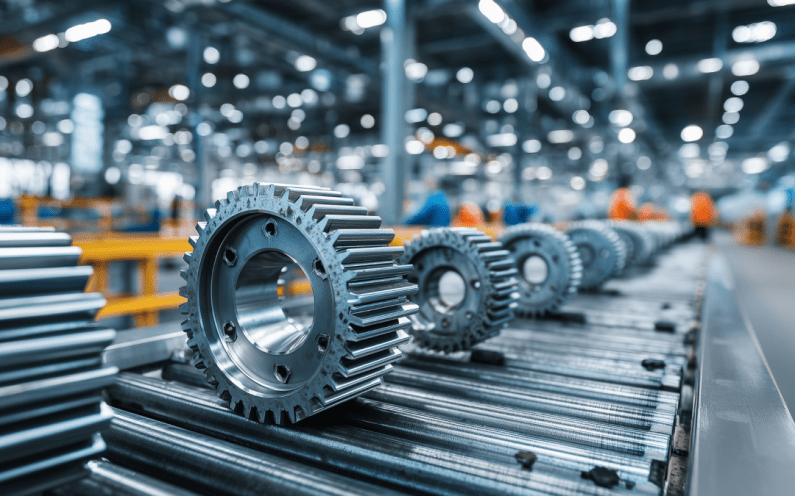
Up to 12.5% of product sales can be lost to rework caused by design errors in manufacturing, and reducing rework by half can increase profits by ~13%.
3D product modeling is often misunderstood as a visual design step. In professional engineering environments, it is far more than that. It is the structural backbone of product development, directly influencing manufacturability, cost control, tolerance integrity, and production timelines.
When executed with precision and manufacturing awareness, 3D product modeling reduces risk before physical parts are cut. When handled casually, it becomes the source of downstream rework, tooling redesign, and supplier friction.
This article explains what 3D product modeling truly involves, how it impacts manufacturing outcomes, and what separates production-grade engineering models from basic CAD geometry.
What Is 3D Product Modeling?
3D product modeling is the process of building a precise, fully defined digital representation of a physical product using professional CAD software. Unlike sketches or renderings, a true engineering model encodes dimensional relationships, material logic, tolerances, and assembly constraints.
A production-ready 3D model typically includes:
- Parametric solid geometry
- Surface modeling for complex curvature
- Assembly relationships and motion constraints
- Defined tolerances and fits
- Material and manufacturing assumptions
- Technical drawing readiness
The 3D model becomes the single source of engineering truth. Every drawing, prototype, CNC program, or mold design traces back to the integrity of that digital file.
Why 3D Product Modeling Determines Manufacturing Success
Manufacturing rarely fails because of bad ideas. It fails because of poorly defined geometry.
When modeling lacks manufacturing intent, several problems appear:
- Machining features are inaccessible to tools
- Injection-molded parts lack proper draft angles
- Wall thickness varies unpredictably
- Assemblies experience tolerance stack-up failures
- Components interfere during real-world assembly
- Surface finishes are incompatible with selected materials
These issues are rarely discovered during modeling if modeling is treated as shape creation rather than engineering control. They surface during prototyping or production, where correction costs increase significantly.
Production-focused 3D product modeling reduces this risk by embedding manufacturing logic directly into the geometry.
| Modeling Issue | What Happens in Manufacturing | Business Impact |
|---|
| Inaccessible machining features | Tools cannot physically reach geometry without redesign | Increased CNC time, rework, and higher production cost |
| Missing draft angles in molded parts | Parts stick in molds or require tool modification | Tooling delays and additional tooling expense |
| Inconsistent wall thickness | Warping, sink marks, and structural weakness | Scrapped prototypes and quality control issues |
| Poor tolerance strategy | Tolerance stack-up causes misalignment in assemblies | Field failures, warranty claims, and rework |
| Assembly interference | Components do not fit during real-world assembly | Production stoppages and redesign cycles |
| Material–finish incompatibility | Surface defects or degraded performance | Rejected batches and supplier disputes |
Core Methods Used in 3D Product Modeling
Parametric Modeling
Parametric modeling defines geometry using dimension-driven relationships. Features update automatically when core dimensions change.
This approach is essential for:
- Mechanical components with tight tolerances
- Functional assemblies
- Configurable product families
- Products expected to evolve through revisions
Parametric discipline enables structured design changes without destabilizing the model.
Surface Modeling
Surface modeling handles complex, organic, or aesthetic geometry. It is common in consumer products, medical devices, and automotive components.
However, surface modeling introduces risk when not carefully managed. Complex curvature must still align with tooling direction, parting lines, and manufacturing constraints. Poorly structured surface models often require rebuilding during mold development.
Surface design without manufacturing validation creates downstream instability.
Reverse Engineering Modeling
Reverse engineering converts existing physical components into editable CAD models. This may involve 3D scanning, geometry reconstruction, and parametric rebuilding.
The goal is not to duplicate shape alone. It is to restore design intent so that future revisions remain controlled and manufacturable.
Reverse engineering is common in:
- Legacy equipment modernization
- Aftermarket component development
- Regulated industries where original files are unavailable
Integrating 3D Product Modeling with Manufacturing Strategy
3D product modeling must align with the intended production method from the beginning. Geometry is never neutral. Every feature, radius, wall thickness, and tolerance decision either supports or conflicts with how the part will actually be produced.
When modeling is done without a defined manufacturing path, design intent and production reality diverge. The result is late-stage redesign during prototyping, tooling modification, or unexpected supplier pushback. These delays are not caused by manufacturing inefficiency. They originate in early modeling decisions that ignored process constraints.
For injection molding, modeling must account for draft angles, parting lines, uniform wall thickness, ribbing strategy, and material shrinkage. For CNC machining, features must respect tool accessibility, realistic corner radii, fixturing requirements, and machining time efficiency. For additive manufacturing, support structures, layer orientation, and post-processing requirements must be considered.
Manufacturing strategy should not be applied after the model is complete. It should shape the model from the first parametric feature. When 3D product modeling is integrated with manufacturing planning early, the model becomes a risk-control tool rather than a geometric placeholder.
Organizations that align modeling with production strategy reduce iteration cycles, shorten time to market, and protect margin before capital is committed to tooling or scale.
Injection Molding Considerations
For molded components, modeling must account for:
- Uniform wall thickness
- Proper draft angles
- Rib and boss design
- Sink mark prevention
- Tooling direction
Ignoring these factors results in mold redesign and increased tooling costs.
CNC Machining Considerations
For machined parts, modeling decisions affect:
- Tool accessibility
- Minimum corner radii
- Material waste
- Fixturing strategy
- Cycle time
Overly complex features increase machining time and cost without adding functional value.
Assembly Logic and Tolerance Strategy
Tolerance stack-up is one of the most common failure points in mechanical assemblies. Effective 3D product modeling includes:
- Defined fits between mating parts
- Realistic tolerance allocation
- Assembly sequence validation
- Interference analysis
These controls prevent field failures and warranty exposure.
Execution-oriented engineering teams treat modeling as early-stage risk elimination, not a documentation formality .
The Financial Impact of Poor 3D Product Modeling
Errors introduced during modeling compound rapidly.
Typical cost consequences include:
- Scrap prototypes
- Tool modification fees
- Supplier disputes
- Delayed product launches
- Missed revenue windows
- Increased warranty claims
The modeling phase represents the lowest-cost opportunity to eliminate design risk. Once tooling or production begins, even small geometry changes become expensive.
Organizations that invest in disciplined 3D product modeling consistently reduce total development cost.
Industries That Depend on High-Precision 3D Product Modeling
Industries where modeling precision directly affects compliance, safety, or operational reliability include:
- Medical device manufacturing
- Industrial automation systems
- Automotive subsystems
- Aerospace components
- Consumer hardware products
In these sectors, dimensional accuracy is not optional. It is foundational.
| Modeling Error | When It Surfaces | Financial Consequence |
|---|
| Geometry inaccuracies | Prototyping phase | Scrap prototypes and repeated builds |
| Incorrect draft or wall design | Tooling stage | Tool modification fees and delays |
| Poor tolerance strategy | Assembly stage | Supplier disputes and rework costs |
| Assembly interference | Pre-production runs | Production stoppages and redesign cycles |
| Late-stage design changes | Production ramp-up | Delayed product launches and missed revenue windows |
| Undetected fit or durability issues | Post-launch | Increased warranty claims and brand damage |
Conclusion: 3D Product Modeling Is a Cost-Control Decision, Not a Drafting Task
Choosing how 3D product modeling is executed is not a technical preference. It is a financial decision.
The modeling phase determines how a product behaves in prototyping, tooling, and full-scale production. Geometry, tolerances, material assumptions, and assembly logic are either validated early or corrected later at significantly higher cost. When modeling is treated as visual drafting, risk moves downstream. When it is treated as engineering control, risk is contained before capital is committed.
Manufacturing technology is widely available. CNC machining, injection molding, additive systems, and global suppliers are not the constraint. Execution discipline at the modeling stage is.
Companies that move efficiently from concept to production work with engineering partners who:
- Model with manufacturing intent from the first feature
- Define tolerances based on real production capability
- Validate assemblies before prototyping
- Align design decisions with tooling strategy
This approach reduces rework cycles, protects launch timelines, and improves margin predictability.
At X-PRO CAD, 3D product modeling is integrated with mechanical engineering and manufacturing planning under a single execution framework. We support product teams, manufacturers, and engineering-led organizations that require precision, coordinated delivery, and production readiness from the earliest stages of development. To discuss your project requirements, contact us at project.inquiries@x-professionals.com or call +1 (571) 583-3710. Additional information about our services is available at www.x-procad.com.



Recent Comments