
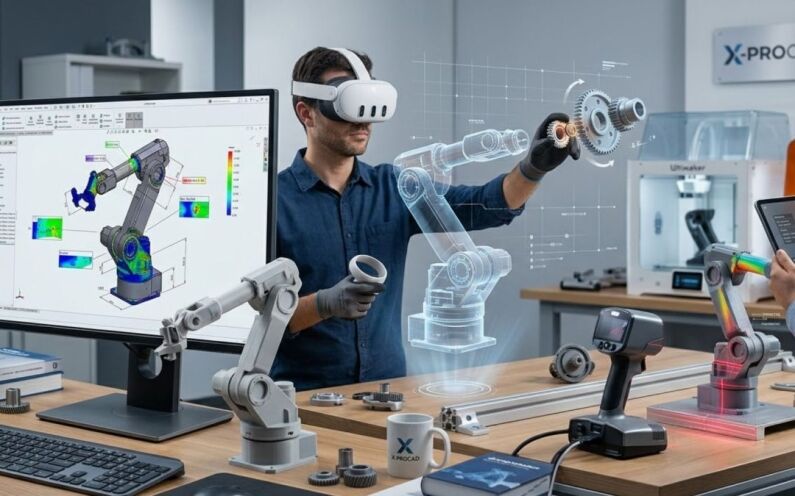
For a long time, computer-aided design was a way to make digital blueprints. It was a tool for precision, but it lived entirely behind a flat glass screen. Engineers and designers would spend hundreds of hours clicking and dragging, trying to visualize how a complex part would actually sit in a real room. While 3D modeling was a huge step forward, there was still a disconnect between the digital file and the physical world.
Today, that gap is closing. Technologies like Augmented Reality (AR) and Virtual Reality (VR) are taking CAD data and pulling it into the physical space. These headsets serve as a high-tech interface for the data. The real work happens in the modeling phase. Without high-quality 3D modeling services, an AR headset is simply a piece of hardware. The precision of the initial draft is what makes the entire immersive experience possible.
Building the Digital Foundation for AR
Augmented Reality works by anchoring a digital object to a real-world surface. Looking through a tablet and seeing a new piece of industrial machinery positioned on the factory floor before buying it is a massive advantage. For this to work, the digital model must be perfect.
The foundation matters for several technical reasons:
- True-to-Life Scale: When a model is built at 1:1 scale, the AR software knows exactly how large it should appear in a room.
- Metadata Accuracy: High-quality mechanical drafting includes the correct weight, material, and part data.
- Surface Alignment: Accurate models align correctly on a desk or floor without drifting or appearing to float in the air.
- Interactive Components: A well-built CAD file allows for manipulating doors or rotating gears inside the AR environment.
This process turns a static file into a functional digital prototype that does not cost anything in physical materials.
The Power of 1:1 Scale Visualization
One of the hardest things to get right in design is human ergonomics. A control panel might look great on a 27-inch monitor, but when it is actually built, the buttons might be too far apart for a person to reach comfortably.
By using VR, the project can be experienced before it exists:
- Reach Testing: Checking if a handle is at the right height for a person standing in that specific space.
- Clearance Checks: Moving through a doorway to see if it provides enough space for heavy equipment.
- Sightlines: Sitting in a virtual cockpit or chair to see if any components block the view.
- Spatial Intuition: Getting a real sense of the size of a room that a flat screen simply cannot provide.
Finding these human-scale errors in the design phase is much cheaper than fixing them during construction.
Enhancing Communication Through 3D Animation
Sometimes, a still image is not enough to explain how a complex machine works. This is where 3D animation and reverse engineering become a vital part of visualization. An exploded view animation shows exactly how every bolt and gear fits together.
When these animations are combined with AR, they become a powerful training tool:
- Step-by-Step Guides: Instead of reading a 50-page manual, workers watch the machine assemble itself in the space in front of them.
- Internal Views: Seeing through the exterior casing of a machine to observe the parts moving inside.
- Safety Training: Learning where the moving parts are located without getting close to a real machine.
- Client Demos: Selling an idea is much easier when the client can see the product working from every angle.
The CAD conversion process becomes much more valuable because the data is used to teach and communicate, removing the mystery of complex systems.
Using 3D Scanning to Bridge the Gap
Not every project starts from scratch. Often, a design must fit onto an existing piece of equipment. This is where 3D scanning and reverse engineering are so important.
The workflow usually looks like this:
- The Scan: A laser scanner turns a physical object into a cloud of millions of digital points.
- The Cleanup: That point cloud is turned into a clean, workable CAD model.
- The Overlay: Using AR to test the fit of a new digital design onto the scan of the old part.
- The Verification: Seeing instantly if there are any gaps or if the new part interferes with a support beam.
This ensures a perfect fit every single time. It is a way to use the real world to verify the digital work, making the whole engineering process much more reliable.
The Technical Reality of Clean Geometry
For a CAD model to function within an AR or VR environment, the geometry must be clean and efficient. High-resolution models often contain excessive lines and data points that can cause a mobile application to lag or crash. Professional drafting services prioritize an optimized polygon count to ensure smooth performance on tablets and headsets without sacrificing visual detail.
This process also involves verifying manifold edges so the 3D surface remains solid and free of visual errors or holes. Proper texture mapping is applied to give the object a realistic appearance, replacing generic shapes with lifelike materials. Finally, file compatibility is managed carefully to ensure the CAD data transfers into various visualization software programs without losing critical information or structural integrity.
Visualization in Specific Industries
The impact of this technology is felt across various fields. In every case, the goal is to remove the guesswork.
- Industrial Machinery: Checking for parts interference and ensuring maintenance workers can access internal components. It helps in planning the layout of entire factories.
- Furniture Design: Seeing how a piece fits into the specific dimensions and lighting of a room before it is shipped. It allows for testing different fabrics or wood finishes in real time.
- Medical Device Design: Allowing surgeons to see a 1:1 scale model of a tool to know how it will feel in the hand during a procedure. This is vital for tools used in sensitive spaces.
- Architecture: Letting a homeowner walk through a new kitchen to choose where the lights and outlets should go. It helps avoid construction changes once the walls are already up.
- Automotive Parts: Checking how a new dashboard or engine component fits within the limited space of a car body.
Why Accurate Drafting Still Comes First
While hardware like headsets and tablets often get the most attention, these tools are only as effective as the data they process. An inaccurate or unoptimized CAD file leads to a failed visualization that does not represent the real-world product. The role of a designer has shifted from creating a simple drawing to building a comprehensive digital asset that serves the entire product lifecycle.
This asset acts as the foundation for several critical business functions. It is used for precise manufacturing on CNC machines, creating high-end marketing visuals, and building AR training guides for new employees. It also functions as a digital twin for long-term maintenance and repairs. Investing in high-quality initial modeling ensures that every future step, from production to marketing, goes smoothly without needing expensive corrections.
Better Visualization for a Sustainable Future
Beyond just being a modern tool, immersive visualization is a huge win for sustainability. In traditional manufacturing, creating multiple physical prototypes leads to a lot of waste. Scrapped metal, plastic, and energy are often the result of trial and error in the real world.
Using digital visualization changes the math:
- Reduced Physical Waste: Designs are perfected in a virtual space, meaning fewer physical prototypes end up as scrap. This is a core benefit of digital prototyping in modern engineering.
- Lower Carbon Footprint: Teams do not have to travel across the country to see a machine in person; they can meet in a shared virtual workspace.
- Longevity of Parts: When parts are designed and tested for perfect clearance using AR, they tend to wear out less quickly.
- Material Optimization: Designers can see exactly where they can reduce the thickness of a part without losing strength, saving on raw materials.
- Faster Repairs: Using AR for maintenance means machines are fixed correctly the first time, preventing further damage or the need for more replacement parts.
It is a more responsible way to build. By using these tools, companies are not just saving money, they are being smarter about the resources they use.
A Simpler Way to See Success
The biggest change in the design world is not the software itself, but how things are viewed. Moving away from cramped 2D views and into a space where the eyes can see things as they really are makes the work feel more natural. When a part can be seen in the air right in front of the viewer, it is understood in a way that a screen can never match. It is not about having the most expensive gear; it is about having the clearest view of an idea. If the data is solid and the model is optimized, the possibilities are endless. It is an exciting jump to make, and it starts with getting that first 3D model exactly right.
Ensuring that a project is built on a professional foundation allows for a smoother transition from a digital file to a functional 3D reality. For those looking to explore how these assets can improve a specific project or workflow, reaching out to discuss3D modeling services can provide the technical clarity needed to move forward.


Recent Comments