
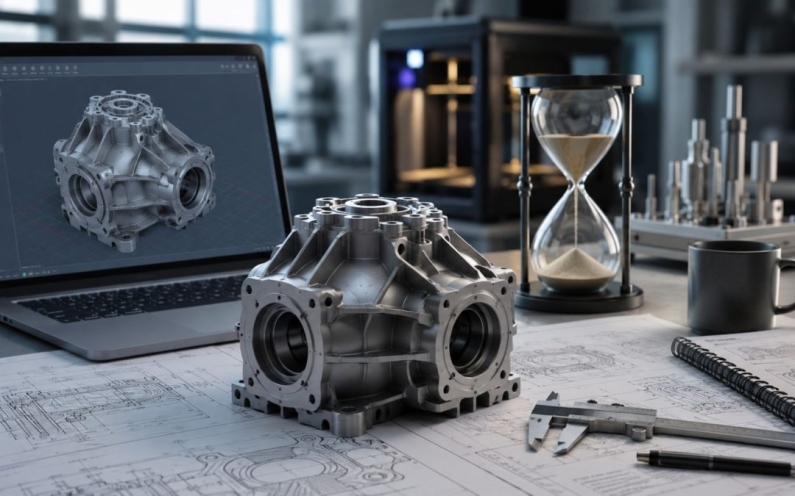
Most people expect a CAD model back in a day or two. That rarely happens with production-ready work. The timeline depends on the part, the process, and how much information is available upfront. A simple bracket is very different from a multi-part consumer product, and the lead time reflects that.
This post covers what makes up total CAD lead time, typical ranges by project type, and what causes delays. If you have ever been caught off guard by how long a project took, most of it comes down to a few predictable factors.
What “Production-Ready” Actually Means
A concept model and a production-ready model are not the same thing. A concept shows shape and form. A production-ready model is what goes to a manufacturer.
A production-ready model includes manufacturing tolerances, material callouts, GD&T (geometric dimensioning and tolerancing) annotations, and a full drawing package. It has to be reviewed, corrected if needed, and signed off before it can be used to make anything. Skipping those steps means the part comes back from the shop floor wrong.
The Stages That Make Up Total Lead Time
The modeling stage is only part of the job. Total lead time includes briefing, modeling, revisions, drawing prep, and file delivery.
- Brief and scope review : 1 to 2 days
- Concept modeling : 2 to 5 days depending on complexity
- Revision rounds : 1 to 3 days per round
- Detail drawings and tolerancing : 2 to 4 days
- Final review and file prep : 1 to 2 days
A straightforward part can take 1 to 2 weeks. A complex assembly with multiple components or tight tolerances can take 3 to 6 weeks.
Typical Lead Times by Project Type
Lead time varies a lot depending on the type of work. A single machined part is a very different job from a consumer product with an enclosure, internal components, and fit requirements. The table below gives working ranges based on common project types. These assume a clear brief, usable reference material, and one to two revision rounds.
| Project Type | Typical Lead Time |
|---|---|
| Single simple part (sheet metal, bracket) | 3 to 7 business days |
| Mechanical assembly (5 to 15 parts) | 1 to 3 weeks |
| Consumer product with enclosure and internals | 2 to 5 weeks |
| Complex mechanism or multi-body system | 4 to 8 weeks |
| Medical device or aerospace component | 6 to 12+ weeks |
| Reverse engineered part (scan to CAD) | 1 to 3 weeks |
More revision rounds stretch these timelines. So does unclear reference material at the start. Medical and aerospace components sit at the longer end because they often require tighter tolerances, specific material standards, and additional documentation beyond a standard drawing package.
How Complexity Affects the Timeline
A flat bracket with a few holes takes a day to model. A housing with snap fits, internal ribbing, undercuts, and assembly interfaces takes much longer.
Mechanical engineering parts that involve motion, load paths, or tight fits between components need more time at every stage. The designer has to check clearances, run interference checks, and verify fit before the model is ready to hand off. Parts that need to work inside a larger system cannot be rushed through that process.
How Revision Rounds Add Time
One revision round is normal. Two is common. Three or more usually means the brief was incomplete at the start.
Each round adds one to three days. That covers receiving feedback, making changes, rechecking geometry and tolerances, and returning the file for approval. Vague feedback like “fix the fit” or “adjust the size” takes longer to act on than a marked-up drawing with specific dimensions. The clearer the feedback, the faster the round closes.
File Format and Output Requirements
Exporting a STEP or IGES file is quick. Preparing a full drawing package with exploded views, section cuts, GD&T callouts, and a bill of materials takes additional time.
Different manufacturing processes need different outputs. CNC machining typically requires STEP or native CAD files. Injection molding requires draft angle analysis and wall thickness checks before the file is usable. 3D printing needs the model exported as STL or 3MF at the right tolerances for the print method. Each output adds verification time before delivery.
What Causes the Most Delays
Most CAD projects that run late come down to the same handful of issues. Some are on the client side, some are on the design side, and some are just part of working on complex parts. Knowing what they are makes them easier to plan around.
- Incomplete brief at the start : Missing dimensions, material, or constraints leads to rework
- Poor reference material : Sketches or photos that are hard to read or measure from slow the modeler down
- Slow client feedback : Waiting days for approval adds days to the end date
- Scope changes mid-project : New requirements reset parts of the timeline
- Multiple approvers : When several people need to sign off, reviews take longer
- Complex geometry : Organic shapes or multi-body interactions take more time to model accurately
Reverse Engineering Lead Times
Reverse engineering starts with a physical part. That part gets scanned or measured, and the data gets converted into a usable CAD model. This adds a step before any modeling begins.
A simple part with clean geometry might take 3 to 5 days. A worn or damaged part takes longer because the engineer has to work out what the original dimensions were before modeling can start. Parts with tight tolerances or complex geometry can take 2 to 3 weeks. The condition of the physical part matters a lot to the final timeline.
How CAD Lead Time Affects Prototyping and Manufacturing
A late or incomplete CAD model pushes the whole project back. Prototyping cannot start until the model is right, and manufacturing cannot start until prototyping is done.
If a model arrives at the prototype stage with errors, it goes back for corrections. That adds time on both sides. The part cannot be built, the correction has to be made, and the model has to be re-approved before anything moves forward. Working with a team that covers CAD design and prototyping and manufacturing reduces that back-and-forth because the same people who built the model understand exactly what the part needs to do in production.
A Realistic Project Timeline
Timelines look different depending on the product, but it helps to see how a typical job actually flows. Here is how a mid-complexity consumer product moves from brief to production-ready files, with two rounds of feedback built in:
| Stage | Duration |
|---|---|
| Brief review and kickoff | 1 to 2 days |
| Initial concept modeling | 4 to 6 days |
| First review and client feedback | 2 to 3 days |
| Revision round 1 | 2 to 3 days |
| Detail drawings and tolerancing | 3 to 4 days |
| Second review | 1 to 2 days |
| File prep and final delivery | 1 to 2 days |
| Total | 14 to 22 business days |
That is three to four and a half weeks for one product. A third revision round adds at least another week. The detail drawing and tolerancing stage is often where projects take longer than expected, especially when the part has multiple surfaces, tight fits, or non-standard material requirements. It is worth planning for that time rather than treating it as an afterthought.
How to Keep Lead Times Shorter
These steps reduce CAD lead time without affecting the quality of the output:
- Send a complete brief : Include dimensions, material, manufacturing method, and any known constraints
- Provide reference material : Physical sketches, photos, or existing drawings all help
- Set revision expectations early : Agreeing on the number of rounds limits scope creep
- Choose a team with manufacturing knowledge : A designer familiar with the target process builds a more accurate model the first time
- Turn feedback around quickly : Slow approvals are one of the most common causes of delay
- Freeze the design before modeling starts : Changes after sign-off take more time than changes made during briefing
The Actual Answer to Lead Time
There is no fixed number. A simple part with a clean brief can be done in under a week. A complex product with multiple stakeholders and several revision rounds can take six weeks or more. Both answers are correct depending on what you are building.
The timeline comes down to how well the project is set up at the start, how complex the part is, and how fast the review process moves. A production-ready CAD model is a manufacturing document. Every dimension, tolerance, and annotation on it feeds directly into how the part gets made. That is why the process takes the time it does, and why rushing it tends to create problems further down the line.
If you have a part that needs a production-ready CAD model, X-Pro handles everything from initial 3D CAD design through to prototyping and manufacturing. Contact us to get a project-specific timeline.



Recent Comments